Here’s a variation on the theme of the Aria from Bach’s Goldberg Variations. It’s not like his variations. I take the notes in each measure of the Aria and load them into an array, and allow the preprocessor to choose the ones it will play from the list using a randomization scheme. I apply another randomization scheme for the durations, and a third to select whether or not a note will play after it’s been chosen. There are a wide variety of different envelopes that can be applied to notes, and variations in the density, and other factors. The result sounds kind of like an ambient piece that Harold Budd might have improvised, if he had access to Prent’s Microtonal Slide Bosendorfers.
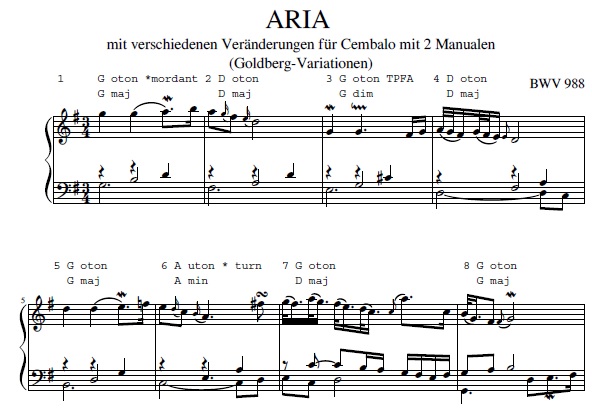
My plan, which as always is subject to success or failure of the idea, is to take a few measures of the Aria at a time and find a variation that brings out the harmonies and with potential extensions of the tuning into higher ratios. Variation one works only with the first eight measures, and I’ll see what the next one will chose from.
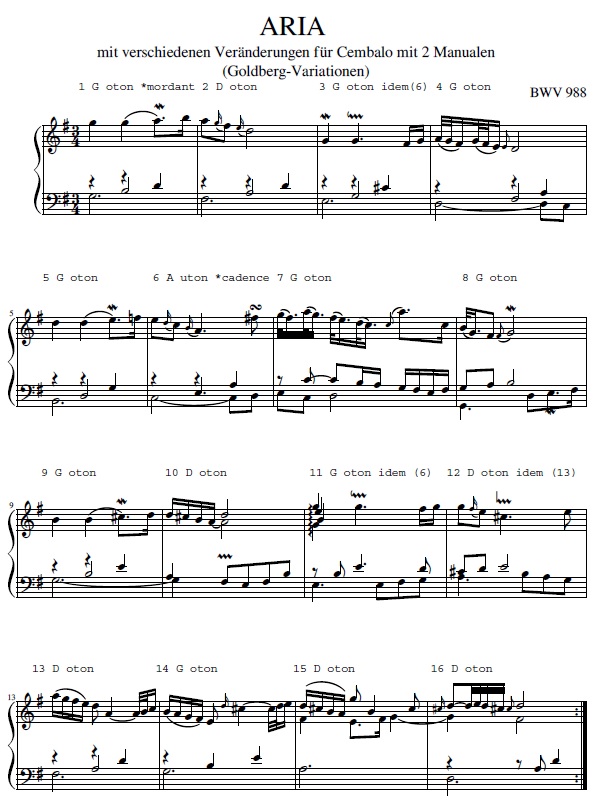
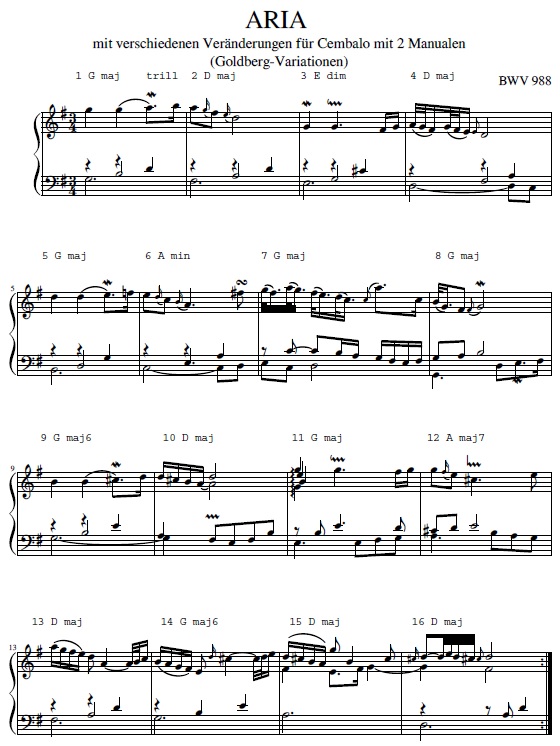
This is the complete Aria upon which the Goldberg Variations are based.
The tuning in this version is still rough, but getting closer to reasonableness. The scales are derived from the tonality diamond to the 31-limit, plus a few others that are a 9:8 above those in the diamond. Think of a diamond, with another one floating 204 cents above it. In fact, why not think of 16 diamonds above, and 16 below, for a tonality cube? I only added these because the key of G major is a challenge in my tonality diamond centered on C 1:1.
In this example, the 9:8 otonality and the 3:2 otonality don’t exist in the true 31-limit diamond. They are a 9:8 above the 1:1 and 4:3 otonalities, which are present. Here are the scales I used. I plan to keep playing around with the alternatives to these to see if I can vex the wolves more. But not too much.
1:1 otonality
4:3 otonality
3:2 otonality
5:4 utonality
9:8 otonality
32:19 otonality
One of the advantages of the use of Prent’s Microtonal Slide Bosendorfer, is the virtual whammy bar. Instead of playing two notes for trills, mordants, and grace notes, I can play each with a single note and apply a unique function table to the pitch using Csound. I now can apply up to three different function tables to each note, so I can simultaneously raise a scale by 204 cents, and also apply an ornament to the same note, and I have one left over for something else. Maybe I can make a de-wolfing function to clean up the last vestiges of the wolfiness.
A day late, but I only finished this part last night and ran out of time to post it. This is the first half of the Aria upon which the Goldberg Variations are based, a piece Glenn Gould recorded twice, once in 1955 and again in 1981. I have listened to them both hundreds of times, and never tire.
My intent at this time is to create some of my own variations using the machine algorithms in my preprocessor. But first I need the original. It has been devilishly hard to transcribe, with all the ornamentation and three distinct lines overlapping in every measure. I’m told it is very challenging on the piano, since it involves lots of hand crossings that are easier on the harpsichord.
The tuning in this version is very rough, and I’ll smooth out the edges later.
This is another “final” version of the third machine series pieces. I added some more randomization methods to get a little ostinato going. Just a bit. The rhythm is the same as the last version. Each measure is played either a normal speed or twice as slowly, or 3x, 4x, 5x, 6x, 7 times slower. This means I stay on a measure for up to seven times longer than normal. I worked to spread the measure lengths out so that they all have the same chance of being chosen. It uses the same scales derived from the tonality diamond to the 31-limit.
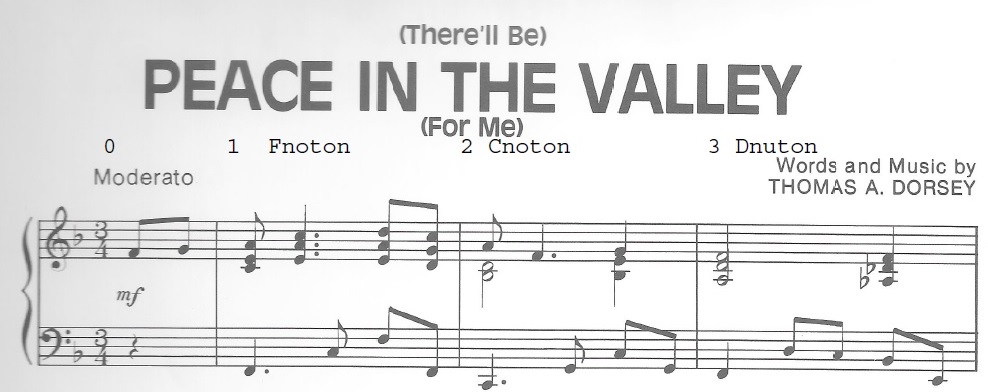
This is a final version of the third machine series pieces. This one disassembles “Peace in the Valley”, a song made famous by Elvis Presley and many others. My version is based on several otonal and one utonal scales from the tonality diamond to the 31-limit.
1:1 otonal
4:3 otonal
9:8 utonal
16:9 otonal
The piece uses the notes in the Thomas A. Dorsey arrangement, but messes with the rhythm, the octaves, and the envelopes quite a bit.
This version offers the option for each measure to be anywhere from 1x to 6x the normal length, using several different sets of pitches, durations, and envelopes. The result is still recognizable, but the listener will have to switch the frame of reference for timing to understand the flow.
This is another version with a few changed keys. I’m using the 16-note otonal scales based on 4:3, 1:1, and 16:9 (F, C, B♭), and utonal scales based on 9:8 (D). The piece is in F, so one would think that the composer wanted the same F in all the measures. But in this case, the F in the 1:1 otonality is located at 471 cents, because I’m using the G major seventh chord in that key, and the F has to be 7:4 to the G. So it’s flat. In 4:3 and 16:9 otonal, it’s at 498 cents, which is probably where it belongs. In 9:8 utonal scale the F is found at 520 cents, 22 cents sharp. It’s kind of like follow the bouncing ball to know where F will be in any given measure.
I also chose a more mellow envelope for the piano tones, so it sounds less harsh.
This is a relatively straight piano performance of the spiritual that Elvis Presley made famous. I altered the tuning a bit. This will form some of the basis for the next machine piece.
Today’s version includes some output from the preprocessor that is more helpful to understand the choices it has made. It also makes extensive use of the p0 randomization pattern, which causes the preprocessor to go through a list and pick the item that has been least often played. As a result, in this version, there are many sections of the piece that were previously unplayed. I had never used this before, and completely forgot that I had included the code to support such a feature. I’ve been playing with the preprocessor for nearly 23 years, and have no idea when I added the p0 pattern, but there it was in the source code, and I used it in this version of the piece.
I added code to the macro source file to list the choices made at different points in the piece. Here’s an example at the beginning of the piece:
1 vamp, bridge, m
ch2 r=10
ch3 r=06
ch4 r=10
ch5 r=04
ch6 r=04
16th = 6 – 10 per measure
9:8 uton c a
loud = mp
a tetrad bridge
4:3 oton d a
8:5 oton d a
16:9 oton d a
1:1 oton d a
4:3 oton d a
The text is in code to help me debug, but it shows what the preprocessor chose. 1 vamp of 480 beats, made up of 8 60 beat measures, played at medium volume. The density is such that channel 2’s notes are played 62% of the time they are called, and silent the remaining 38% of the time. Channel 3 is played only 38% of the time called, and channels 5 & 6 are played only 25% of the time. A sixteenth note gets 6 beats, and there are 10 of them per measure, which is fairly slow. The 16-tone scale is the 9:8 utonality, and the tetrad derived from that scale is primarily the “a” tetrad, with slides from the “c” to the “a”. The “a” tetrad in the utonal scale is 12/12:10:8:7. It makes a sweet minor triad with a sharp 7th. The “c” tetrad is more challenging, with ratios of 46/46:38:31:27. It’s way down in the subharmonic series. The loudness of the bridge is medium. This is an “a” tetrad bridge. The bridge is F major, Ab major, Bb major, C major, F major, which coincidentally is the bridge for Sam & Dave’s “Hold On, I’m Comin'”. Go figure. Here’s the next few measures to get an idea of what you may be hearing.